CLAERobot behavior steering

Closed-loop affine activation editing

Steering Multirobot Behavior via Closed-Loop Affine Activation Editing

University of Southern CaliforniaNVIDIA

University of Southern California NVIDIA
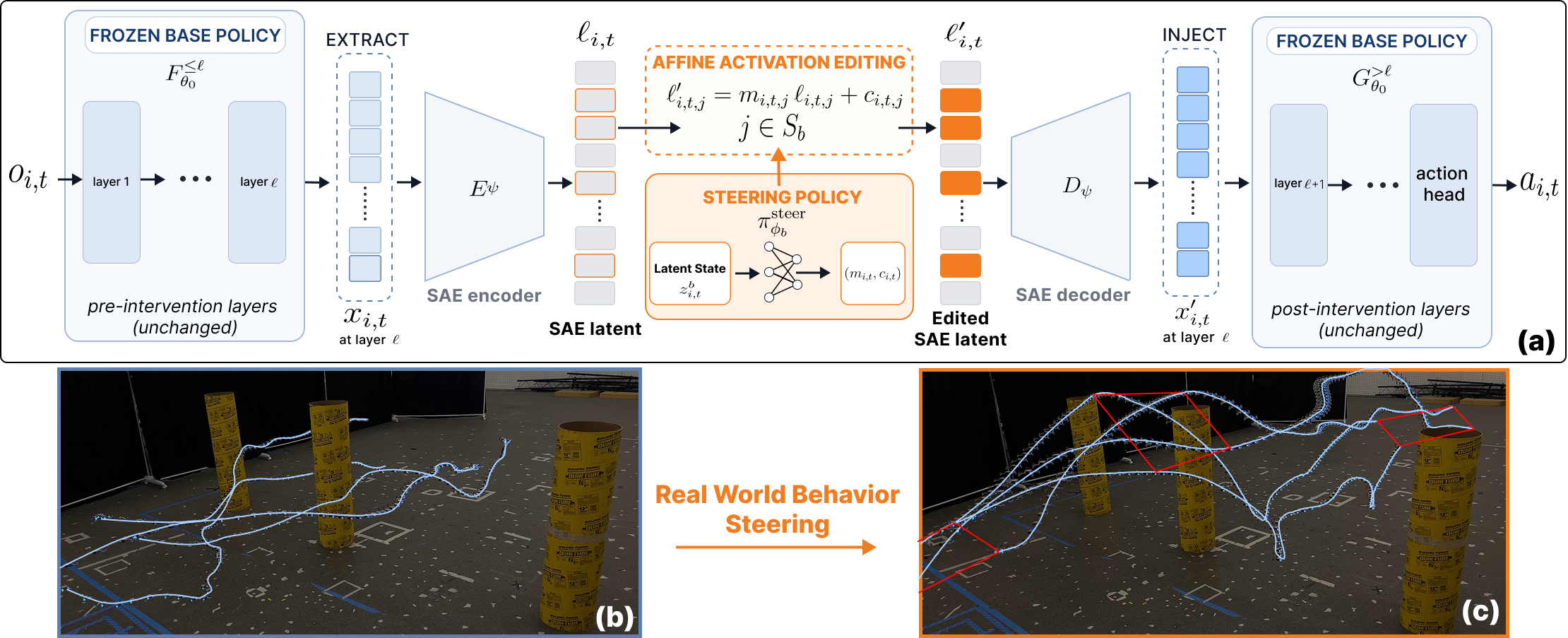
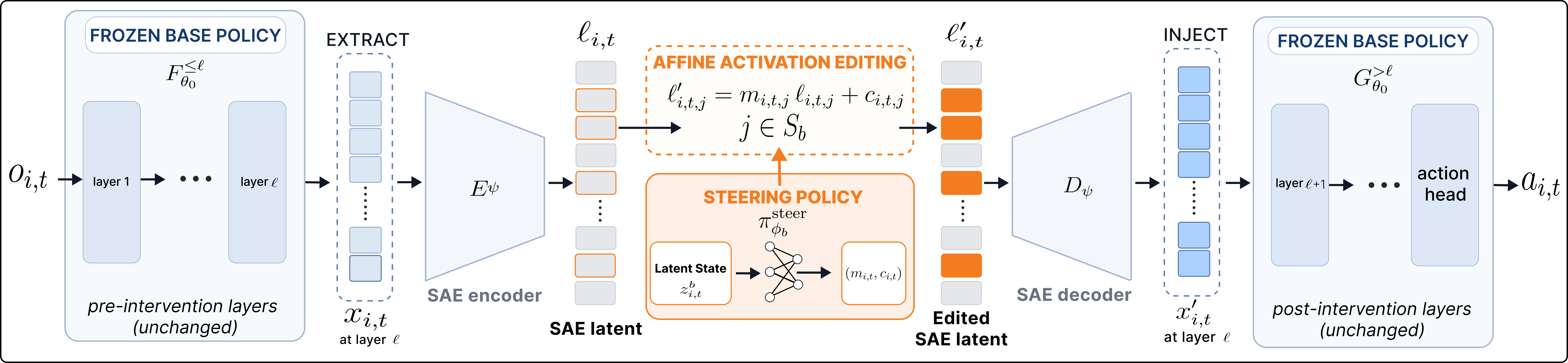
CLAE activation-editing pipeline above a real-world comparison of base-policy and CLAE quadrotor formation trajectories Enlarge figure
CLAE steers a frozen policy through state-dependent activation edits (a). Four quadrotors navigate independently under the base policy (b), while CLAE steers them toward a desired formation (c).

Abstract

CollapseRead the abstract

Real-world robots need to adapt their behavior beyond the envelope of their pre-trained policy. Policy finetuning or retraining are options, but they risk catastrophic forgetting, degrading the pretrained policy’s base performance. To combat this, we introduce CLAE: Closed-Loop Affine Activation Editing, an inference-time framework for steering the behavior of a frozen policy by editing intermediate activations while keeping the base policy weights and downstream action head untouched. CLAE approaches behavior steering as a closed-loop problem whose outputs edit policy activations that adapt online to the robot state, environment, target behavior, and multi-robot context. It trains a sparse autoencoder over frozen-policy activations, selects behavior-relevant latent features via post-hoc probing, and learns a lightweight RL-based steering policy that applies state-dependent affine edits to selected latents during inference. We validate CLAE on a frozen multi-quadrotor navigation policy trained to perform a single task: navigating robots to a set of goal locations while avoiding obstacles. Through extensive simulations and physical tests, we show that while navigating to their goal positions, CLAE can 1. steer individual robot behavior by controlling each robot’s velocity profile; 2. coordinate multirobot behavior by preserving a desired formation, and 3. produce entirely new behavior wherein robots are required to reduce their exposure to surveillance cameras in the environment.


02 / Method

Method Overview

CLAE treats behavior steering as a closed-loop problem. Edits adapt to the robot state, the environment, the target behavior, and neighboring robots at each policy step.

How CLAE works

Follow an activation through the editing pipeline.

Step 1 of 6

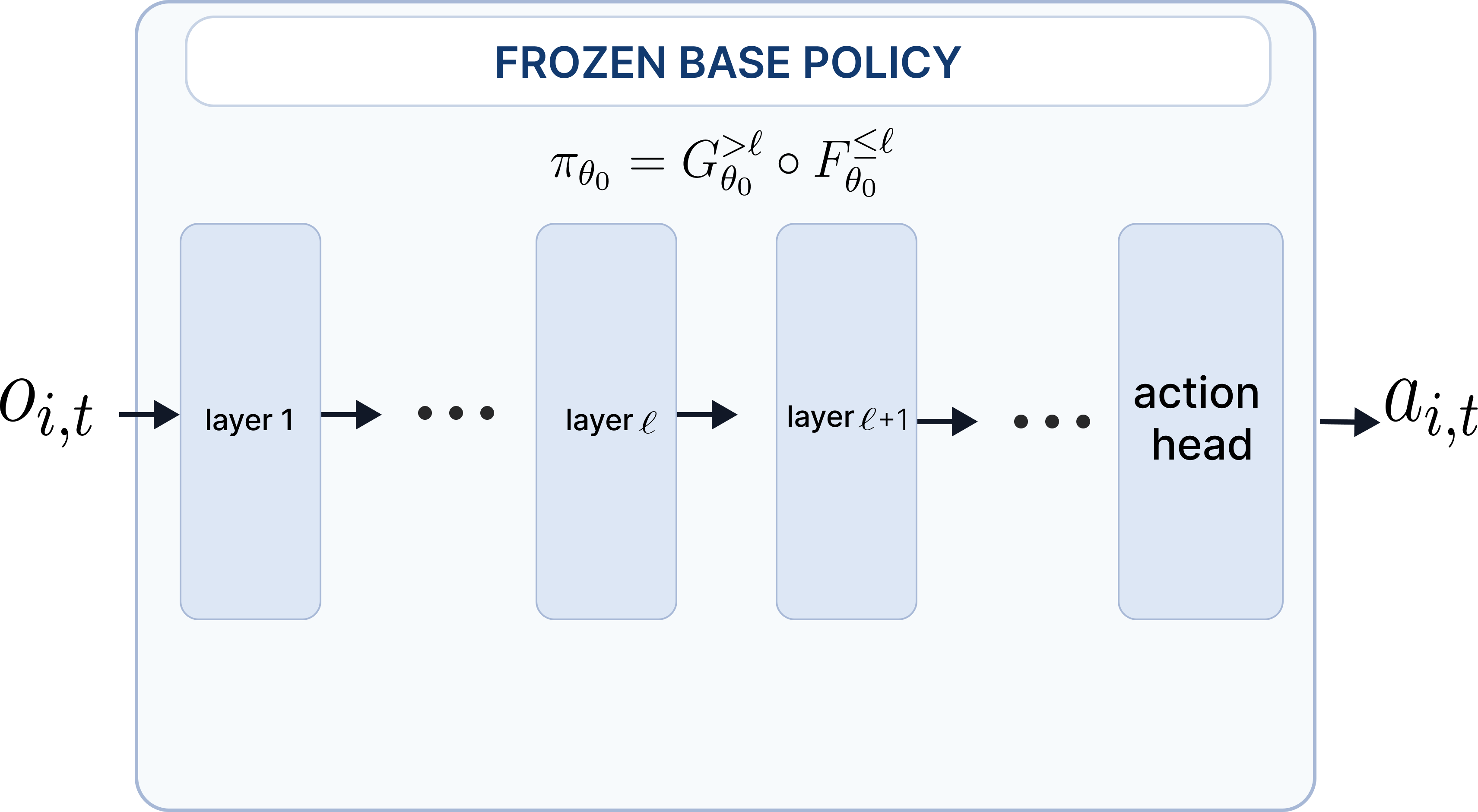
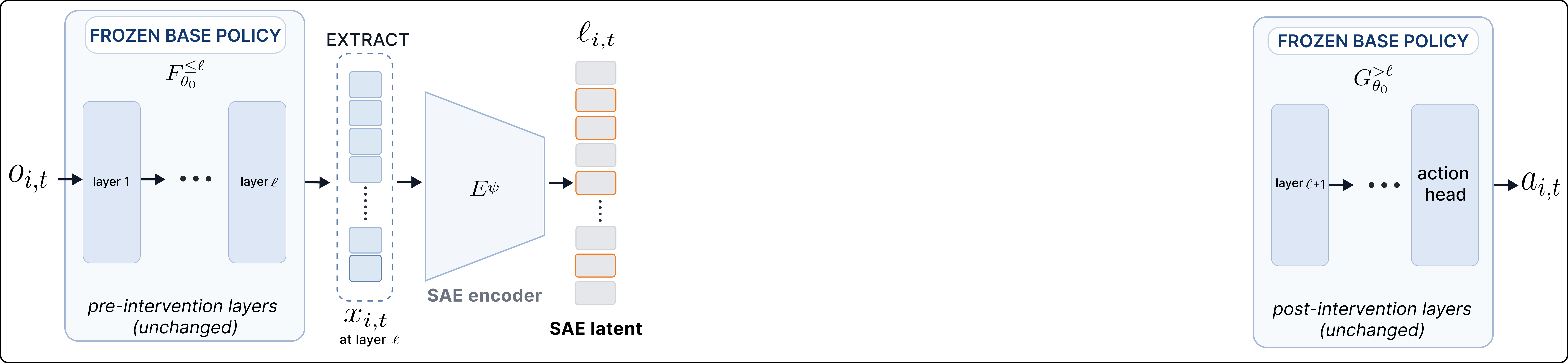
Start with the frozen base policy

The pretrained navigation policy maps observations to robot actions. Its weights, architecture, and downstream action head stay fixed throughout CLAE training and deployment.

Step 2 of 6

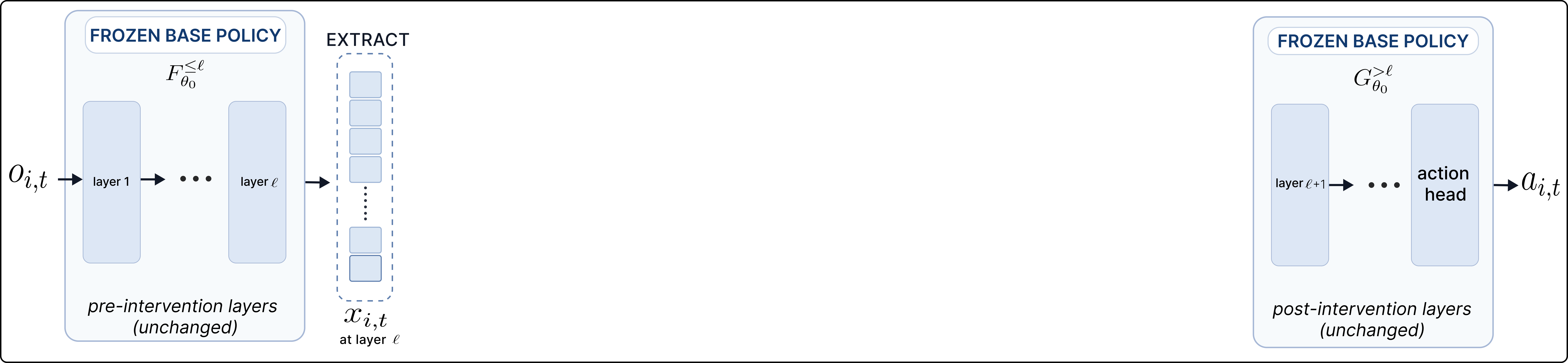
Extract an intermediate activation

At each policy step, intercept the activation at a chosen internal layer. This creates an editing interface inside the policy, before the remaining frozen layers compute the robot’s action.

Step 3 of 6

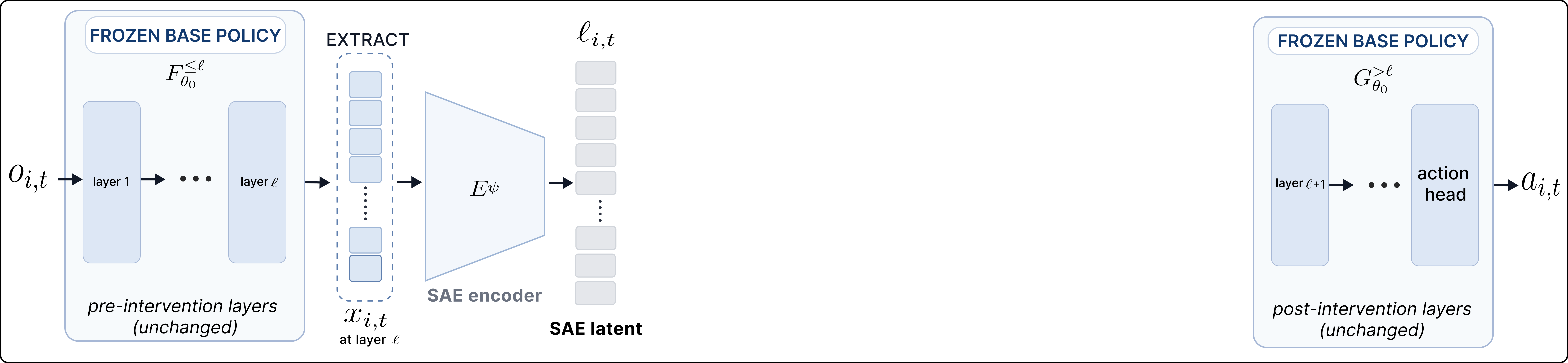
Encode into a sparse latent basis

A sparse autoencoder trained on frozen-policy activations maps the intercepted activation into a sparse latent representation. This provides a feature basis for selective intervention.

Step 4 of 6

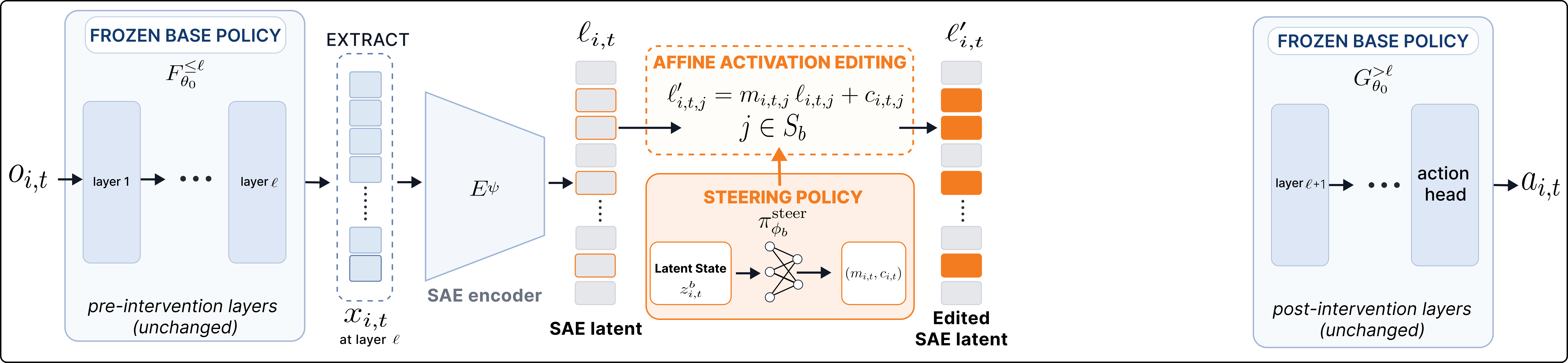
Select behavior-relevant features

Post-hoc probes use rollout-derived behavior metrics to select a compact latent set for each target behavior. Only these selected features can be edited; the remaining SAE latents pass through unchanged.

Step 5 of 6

Predict state-dependent affine edits

A lightweight RL steering policy uses the current context to predict multiplicative gains and additive offsets for the selected features. These edit parameters change online with the robot state, environment, target behavior, and teammates.

Step 6 of 6

Decode, reinsert, and act

The SAE decoder maps the edited latents back to a policy activation. Reinsert it into the frozen network, let the original action head produce the robot action, and repeat the editing process with the next observation.

Scroll the diagram sideways or tap it to enlarge.

  1. 01

    Extract & encode

    Intercept an intermediate activation of the frozen policy. A sparse autoencoder maps it into a sparse latent basis.

  2. 02

    Select & steer

    Post-hoc behavior probes select relevant latents. A lightweight, behavior-specific RL steering policy predicts their affine gains and offsets online.

  3. 03

    Decode & act

    Decode the edited latents and reinsert the activation. The original frozen downstream layers produce the robot’s action.

The editing interface

ℓ′j = mjj + cj

Affine edits apply only to the selected latent features. Unselected latents pass through unchanged; the base policy weights and action head remain fixed.

Training and deployment. The SAE and behavior-specific steering policies are trained separately from the frozen base policy. At deployment, the steering policy chooses edits online; it does not update the base policy’s weights.

03 / Demonstrations

Three behaviors. One frozen base policy.

Compare the original navigation policy with CLAE in the same simulated environments. Each task uses its own steering policy and behavior objective.

01

Individual behavior

Velocity tracking

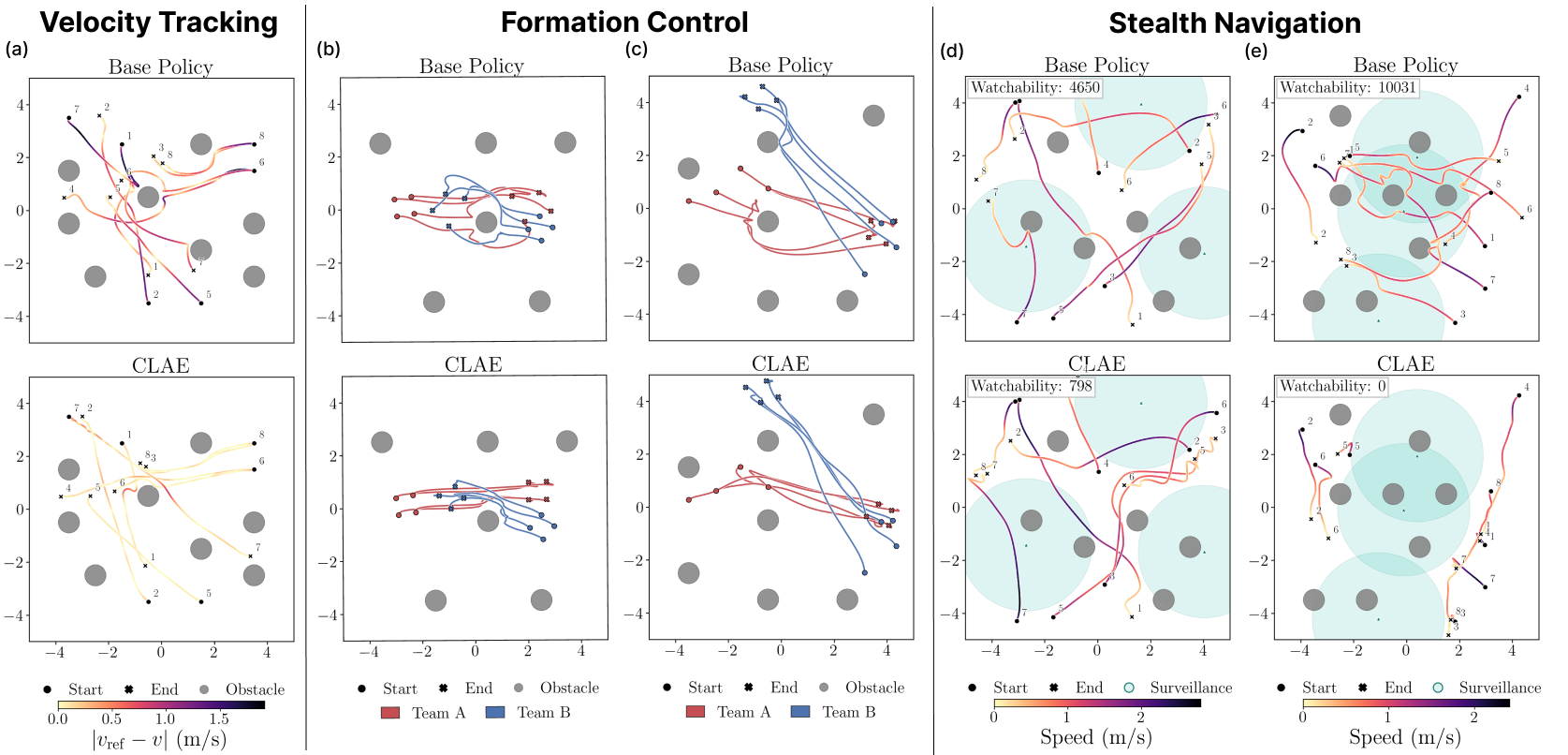
CLAE adapts each robot’s motion to a time-varying reference. Trajectory color indicates velocity-tracking error; lighter trajectories indicate closer tracking.

Reference velocity tracking

Base PolicyNavigation
CLAENavigation + behavior steering

Both policies navigate the same scene. CLAE follows the requested velocity profile more closely.

Show sim viewHide sim view
Native simulation replay. Base Policy (left), CLAE (right).Both policies navigate the same scene. CLAE follows the requested velocity profile more closely.
02

Collective behavior

Formation control

The frozen base policy navigates independently. CLAE uses teammate context to steer robots toward a target square formation. Colors identify robot teams.

Starting in formation

Base PolicyNavigation
CLAENavigation + behavior steering

With square-structured starts and goals, CLAE keeps the team closer to the desired geometry around obstacles.

Show sim viewHide sim view
Native simulation replay. Base Policy (left), CLAE (right).With square-structured starts and goals, CLAE keeps the team closer to the desired geometry around obstacles.

Starting at arbitrary positions

Base PolicyNavigation
CLAENavigation + behavior steering

From unstructured starts, CLAE brings robots toward the target square as they navigate to their goals.

Show sim viewHide sim view
Native simulation replay. Base Policy (left), CLAE (right).From unstructured starts, CLAE brings robots toward the target square as they navigate to their goals.
03

New behavior

Camera-aware navigation

Camera avoidance was absent from the base policy’s training objective. Blue regions indicate camera coverage, and trajectory color denotes speed.

Sparse camera coverage

Base PolicyNavigation
CLAENavigation + behavior steering

When low-exposure paths exist, CLAE routes around camera regions or crosses them faster to reduce cumulative exposure.

Show sim viewHide sim view
Native simulation replay. Base Policy (left), CLAE (right). Teal outlines indicate camera coverage.When low-exposure paths exist, CLAE routes around camera regions or crosses them faster to reduce cumulative exposure.

Dense camera coverage

Base PolicyNavigation
CLAENavigation + behavior steering

With dense coverage, CLAE prioritizes lower exposure over goal progress. In this example, some robots stop short of their goals.

Show sim viewHide sim view
Native simulation replay. Base Policy (left), CLAE (right). Teal outlines indicate camera coverage.With dense coverage, CLAE prioritizes lower exposure over goal progress. In this example, some robots stop short of their goals.
View the trajectory summary
Base-policy and CLAE trajectories across velocity tracking, structured and arbitrary formation starts, and sparse and dense camera coverage Enlarge figure
Behavior at a glance. The base policy (top row) and CLAE (bottom row) in five representative scenarios. This is Figure 2 from the paper; each column corresponds to a demonstration above.

04 / Results

Measurable changes in behavior.

Velocity error≈3.8×0.322 0.085 m/s
Formation error≈3.2×0.280 0.086
Camera exposure≈3.1×3596.6 1151.3

Reduction factors in simulation relative to the frozen base policy. See results

For each task, results are averaged over the same 1,000 distinct simulated environment configurations. Lower values indicate better behavior-specific performance.

Behavior-specific results · Base Policy versus CLAE
MetricBase PolicyCLAEReduction factor
Velocity error (m/s) 0.3220.085≈3.8×
Formation error 0.2800.086≈3.2×
Camera exposure (watchability) 3596.61151.3≈3.1×

Formation error measures deviation from the target square geometry. Watchability counts cumulative robot–camera visibility events per episode.

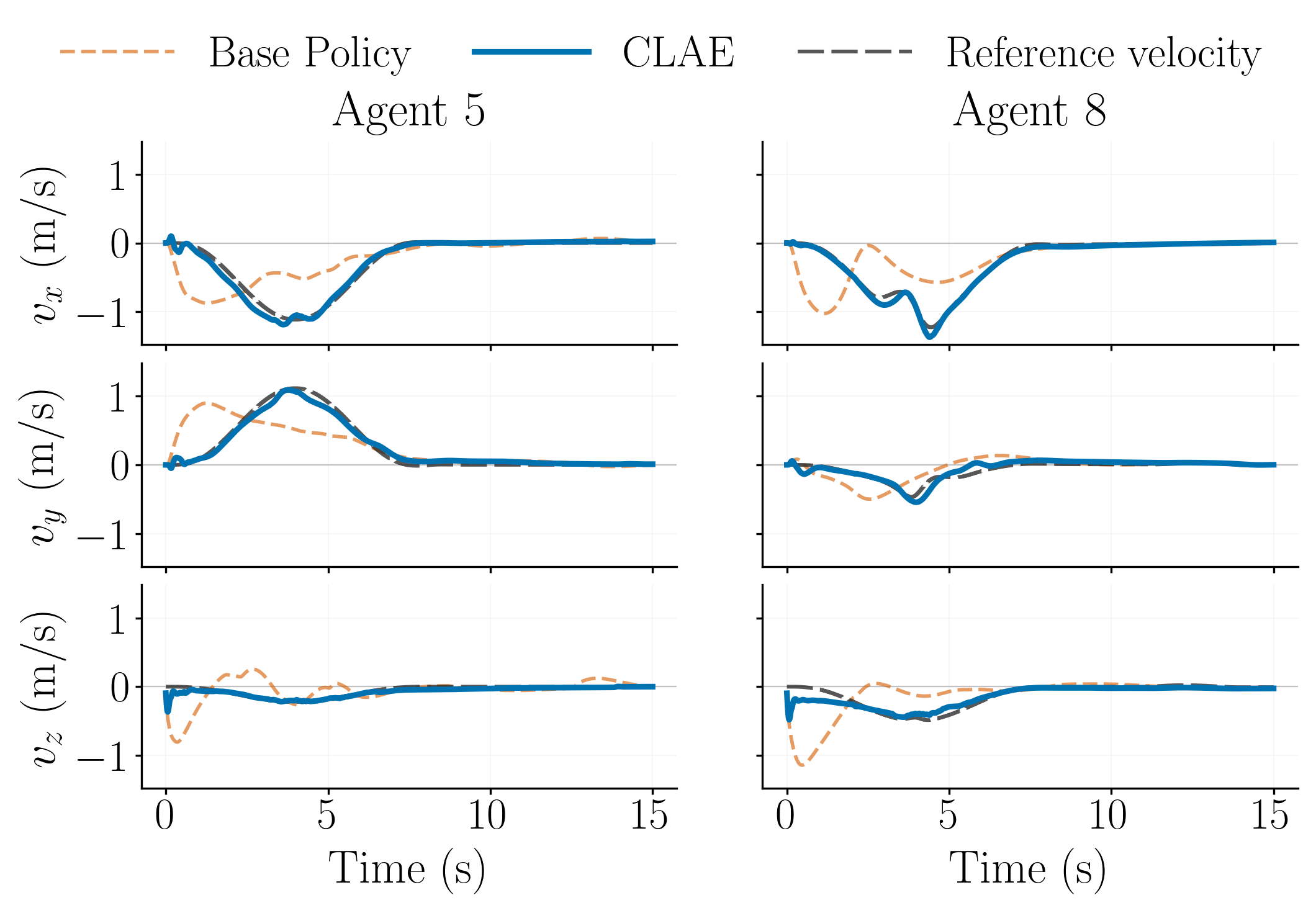
Following the reference. Animated per-axis velocity traces for Agents 5 and 8. The moving markers and shared time cursor compare CLAE (blue) and the Base Policy (orange) against the reference velocity (gray). Open full-size video
View static Figure 3
Velocity traces on x, y, and z for Agents 5 and 8: CLAE follows the reference more closely than the base policy Enlarge figure
Figure 3 from the paper. The complete velocity traces, shown together for comparison. Blue: CLAE. Orange: Base Policy. Gray: reference velocity.

The paper includes additional activation-editing baselines, residual-action learning, diffusion-policy steering, and design ablations. Read the full evaluation

05 / Real world

From simulation to real flight.

We deploy CLAE zero-shot from simulation on four Crazyflie 2.1 quadrotors to steer the team toward a desired formation while navigating around obstacles.

Base PolicyNavigation
CLAENavigation + formation

The base policy reaches the goals by splitting around the middle obstacle. CLAE keeps the team closer together. The clips have different durations and play independently at their original speeds.

100 Hz

Entire pipeline onboard

Zero-shot

Transfer from simulation

4 quadrotors

Coordinated formation control

The frozen policy, sparse autoencoder, and steering policy run on each robot’s STM32 microcontroller, alongside onboard state estimation and inter-robot communication.

06 / Citation

Cite this work.

If CLAE is useful to your research, please consider citing the paper.

BibTeX · arXiv preprint, 2026
@misc{das2026steeringmultirobotbehavior,
  title = {Steering Multirobot Behavior via Closed-Loop Affine Activation Editing},
  author = {Satyajeet Das and Darren Chiu and Shashank Hegde and Gaurav S. Sukhatme},
  year = {2026},
  eprint = {2606.11489},
  archivePrefix = {arXiv},
  primaryClass = {cs.RO}
}

Research figure

Open full-resolution image